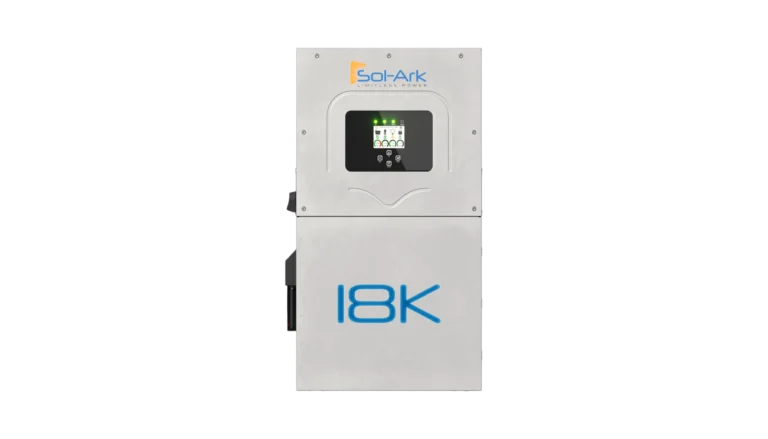
Sol-Ark 18K-2P 48V Hybrid Inverter, 18kW Battery Output, 28.8kW Solar Input, IP65 All-in-One Inverter, UL 1741
SKU: 18K-2P
Product Summary
Sol-Ark’s 18K-2P hybrid inverter continuously outputs up to 18kW from batteries alone and can pass up to 200A from the grid. It’s ideal for off-grid systems, on-grid systems, and systems selling to the grid.
Specifications:
- Continuous output power: 18kW @ 120/240V
- 3x MPPTs, up to 500Vdc max
- 2x inputs per MPPT
- MPPT operating voltage range: 150-425V
- Max. usable input current per MPPT: 36A
- Max. short circuit current per MPPT: 54A
- Max. utilized solar power: 28.8kW
- Max. charge/discharge current: 350A
- Max. grid bypass: 200A
- Certified to UL 1741 Standards
- Weight: 137lbs
- Dimensions (H×W×D): 33.98×18.27×11.10in
Log in to check member price and detailed stock information.
Log in to see additional stock details


Current Connected is YOUR Sol-Ark product specialist
About the Sol-Ark 18K-2P Hybrid Inverter
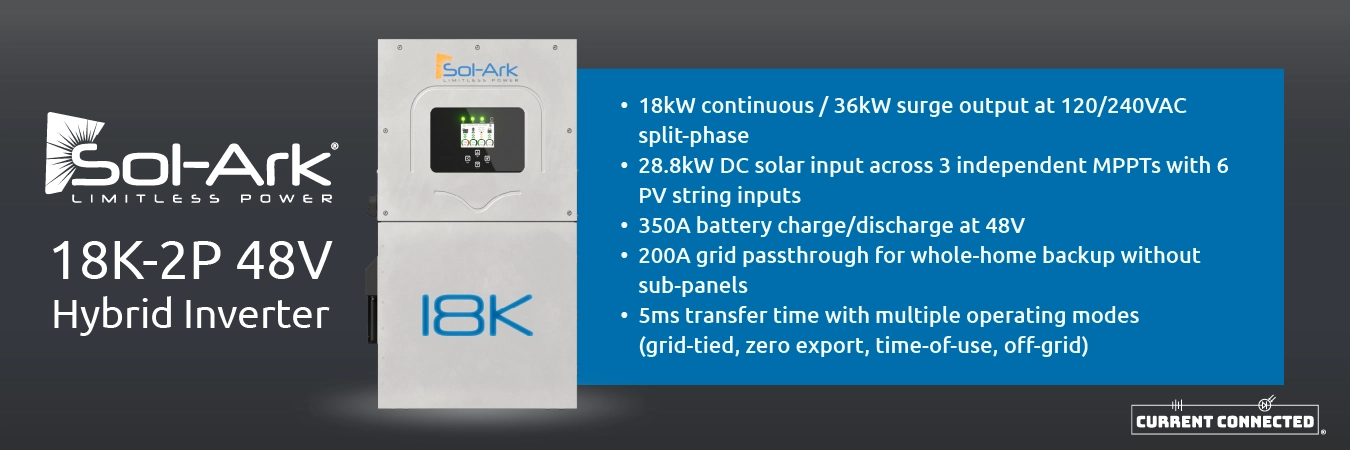
The Sol-Ark 18K-2P is an all-in-one hybrid inverter that combines an 18kW inverter, three MPPT solar charge controllers, a battery charger, automatic transfer switch, and grid interface in a single outdoor-rated enclosure. It outputs 18kWAC continuous at 120/240V split-phase with a 36kW surge capacity for 10 seconds, which is enough to start central air conditioners, well pumps, and other heavy motor loads without a soft start. The 200A grid pass-through means you can back up your entire main panel without building a critical loads subpanel, and a 5ms transfer time keeps electronics running through the switch.
Solar Input
The 18K-2P has three independent MPPT channels with two string inputs each (six total PV inputs). Each MPPT operates across a 150 to 425V range with a maximum usable current of 36A and a short circuit rating of 54A. Combined DC-coupled solar input is 28.8kW. For systems that need more PV, the inverter also supports up to 19.2kW of AC-coupled solar from a separate grid-tied inverter, bringing total possible solar input over 40kW. The three independent MPPTs allow arrays on different roof faces or orientations to be tracked separately without production losses from mismatched strings.
Battery Integration
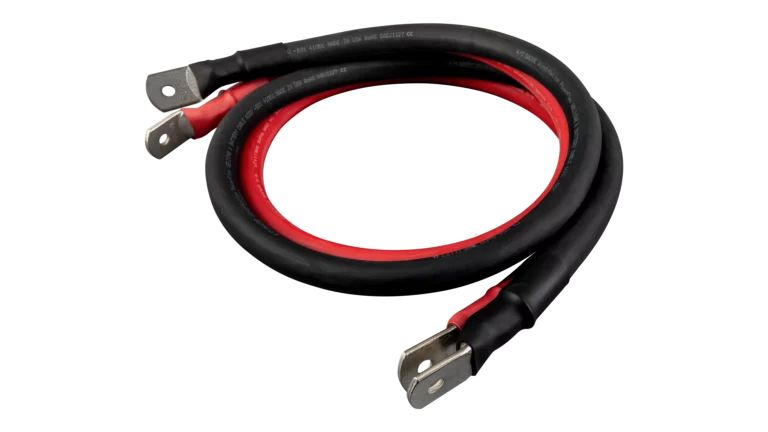
The inverter charges and discharges 48V battery banks at up to 350A. It requires an absolute minimum battery bank of 200Ah. CAN and RS485 communication (RJ45 connectors) support closed-loop BMS integration with most major lithium battery brands including Pytes, Renon, and others. The inverter is battery agnostic and also works with lead-acid banks for budget-conscious installations, though lithium is recommended for systems at this power level.
Operating Modes
The 18K-2P supports multiple operating modes that can be configured through the onboard LCD or the MySolArk monitoring app. Grid-tied mode sells excess solar production back to the utility. Zero export mode uses solar and battery without sending power to the grid. Time-of-use mode charges batteries during off-peak hours and discharges during peak rate periods. Off-grid mode operates entirely independent of the grid. Smart load outputs let you prioritize specific circuits based on battery SOC and available solar. These modes are programmable by season and time of day.
Grid Pass-Through and Transfer
The 200A pass-through rating is one of the defining features of this inverter. Most residential hybrid inverters require a critical loads subpanel because they can only pass 30 to 50A. The 18K-2P passes 200A, which means it can sit between the utility meter and your main panel and back up the entire house without rewiring. When grid power fails, the inverter transfers to battery in approximately 5ms, fast enough that computers, networking equipment, and most sensitive electronics continue running without interruption.
Rapid Shutdown and Safety
The 18K-2P includes RSD (Rapid Shutdown) capability for NEC compliance. Wire an external RSD button like the IMO RSD Initiator to the inverter, and when activated, the 18K shuts down and sends a shutdown signal to any connected RSD transmitters and devices on the array. The inverter also includes integrated AFCI (Arc Fault Circuit Interrupter) and GFDI (Ground Fault Detector/Interrupter) protection. Sol-Ark designs the 18K firmware in the US, and all monitoring data is processed domestically.
Enclosure and Installation
The IP65 / NEMA 3R enclosure is rated for outdoor installation in temperatures from -40°F to 140°F (-40°C to 60°C). At 137 lbs and 34 x 18 x 11 inches, it mounts on an exterior wall adjacent to the main panel or battery enclosure. The all-in-one design means no external fuses, breakers, or combiner boxes are required for the inverter itself. A dedicated generator input with auto-start functionality is built in for systems that need generator backup in addition to solar and battery.
Scalability
Up to 12 Sol-Ark 18K-2P units can be paralleled for larger installations, providing up to 216kW of continuous output. Three or more units can be configured for three-phase operation. This makes the 18K-2P suitable for large residential, multi-family, agricultural, and light commercial applications that can start with one unit and expand over time.
Monitoring
The MySolArk app provides real-time monitoring and configuration from any smart device or desktop. Connect the included WiFi dongle to the inverter and the app shows battery SOC, solar production, grid import/export, load demand, and historical data. The inverter is also VPP (Virtual Power Plant) ready for utility demand response programs.
Recommended Accessories




Frequently Asked Questions
No. The 200A grid pass-through allows the 18K-2P to sit between the meter and your main panel and back up the entire house. Most other residential hybrid inverters require a subpanel because they can only pass 30 to 50A. This is one of the primary reasons to choose the 18K-2P.
The 18K-2P is battery agnostic and works with any 48V battery bank. It communicates via CAN or RS485 (RJ45 connector) for closed-loop BMS integration with most lithium battery brands. It also supports lead-acid batteries. A minimum battery bank of 200Ah is required provided the batteries can provide at least 350A for the inverter's full output demand.
Approximately 5ms. This is fast enough that computers, servers, networking equipment, and most sensitive electronics continue operating without restarting. In our testing, we found the fastest transfers occur when the low voltage thresholds are set close to the normal operating voltage to trigger transfers as soon as an interruption in power begins.
Yes. A dedicated generator input with auto-start functionality is built in. The inverter can signal a compatible generator to start when battery SOC drops below a set threshold, and shut it down when batteries are sufficiently charged. This same input also supports AC coupling with grid-tied microinverters or string inverters. In an AC-coupled configuration, the existing grid-tied inverter feeds up to 19.2kW of solar production into the generator port, which the 18K-2P uses to charge batteries and supply loads. This makes the 18K-2P a strong option for adding battery backup to an existing grid-tied solar system without rewiring or replacing the original inverter.
Yes, if your utility allows it. Grid-tied mode exports excess solar production to the utility for net metering credit. However, many customers prefer zero export mode, which uses solar and battery to offset grid consumption without ever sending power back. This is common in areas where the utility doesn't offer favorable net metering rates, charges fees for grid export, or where the interconnection approval process is slow or restrictive. The inverter actively monitors grid flow and curtails production or diverts to battery charging to prevent export. Time-of-use mode is another option, where the inverter charges batteries during cheap off-peak hours and discharges during expensive peak periods to minimize your bill without exporting. The inverter is UL 1741 certified and IEEE 1547-2018 compliant for grid interconnection when export is desired.
The 18K-2P's zero export mode targets net-zero grid export by curtailing solar production or diverting it to battery charging when household demand is met. In practice, brief spikes of export can still occur during rapid load changes before the inverter adjusts, so zero export is a best-effort setting rather than an absolute guarantee. Whether this mode requires utility notification or permitting depends on your jurisdiction. Some areas require an interconnection agreement for any grid-connected inverter regardless of export settings, while others only require it for systems that actively export. Contact your local utility and AHJ (Authority Having Jurisdiction) before installation to understand what's required in your area.
The two battery ports are internally paralleled, not isolated. They share the same bus, so they are not two separate battery inputs for different voltage banks. You can connect a single battery bank across both ports to split current and keep cable sizes manageable, or you can connect two matched battery banks (same voltage, same chemistry) one on each port. Either way the inverter sees one combined battery bus. The communication cable (CAN or RS485) still daisy-chains across all batteries regardless of which port they're physically connected to.
Customer Reviews
No reviews yet. Be the first to review this product!