
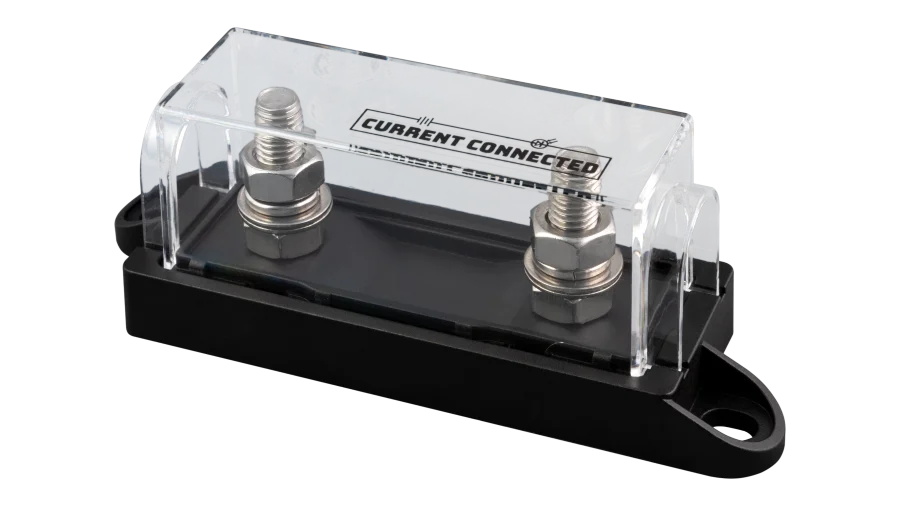
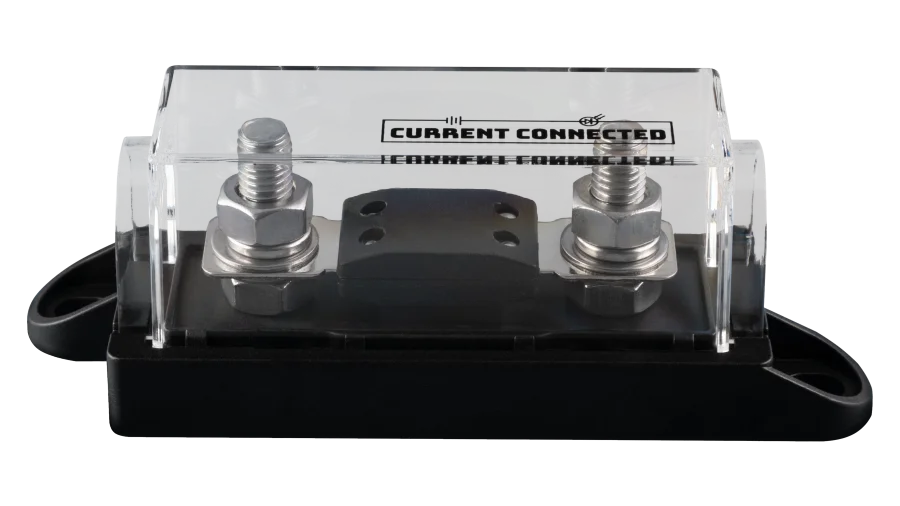
MEGA Fuse Holder, Fits MEGA and AMG Fuses, Up to 70Vdc, 5/16" Steel Studs, Accepts Lugs up to 1/0 AWG, Clear Cover, for 12V/24V/48V Energy Storage Systems
SKU: CC-MFH
Log in to check member price and detailed stock information.
| Need more than what's available? Tell us what you need and we can source it for you. |
Product Summary
Single-fuse holder for MEGA and AMG fuses, used to protect inverter, charger, and DC distribution circuits in 12V, 24V, and 48V systems. Two 5/16" steel studs accept lugs up to 1/0 AWG, and a clear cover insulates the live terminals while keeping the fuse visible.
Specifications:
-
Compatible fuses: MEGA and AMG format (sold separately)
-
Max voltage: 70V DC
-
Terminal stud size: 5/16"
-
Stud material: Steel
-
Max cable lug: 1/0 AWG
-
Recommended torque: 89 in-lb (10 Nm)
-
Cover: Clear insulating cover, included
-
Mounting: Two-hole tab mount
About the MEGA Fuse Holder
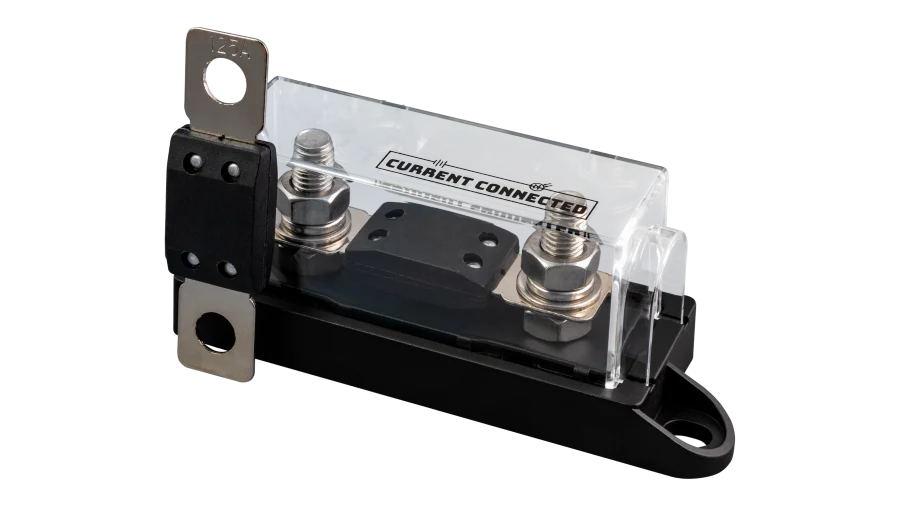
This is a single-fuse holder for bolt-down MEGA fuses, used to protect individual DC circuits in 12V, 24V, and 48V battery systems. A molded base carries two 5/16" steel studs, the fuse bolts across them, and your cable lugs land directly on top of the fuse tabs. A clear cover fits over the assembly to insulate the live terminals while leaving the fuse visible for inspection.
MEGA and AMG Fuse Compatibility
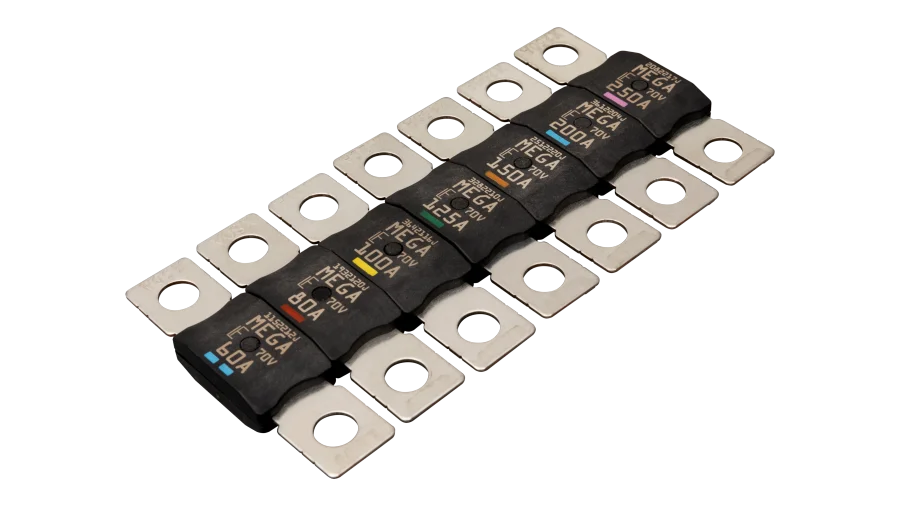
The holder accepts any standard MEGA-format fuse, including Littelfuse MEGA, Victron MEGA, and Bussmann AMG fuses, which share the same bolt-down footprint. ANL fuses use a longer body with different hole spacing and will not fit. The holder is rated to 70V DC, but the fuse sets the real voltage limit for your system. Standard MEGA and AMG fuses are commonly rated 32V DC, which covers 12V and 24V systems only. For a 48V bank, use a fuse rated 58V or higher, such as the Littelfuse MEGA 70V (2,500A interrupt rating at 70V DC) or Victron MEGA fuses.
Using a Single MEGA Fuse Block on Branch Circuits
A MEGA holder belongs on the branch circuits leaving your positive busbar: inverter and inverter/charger feeds, DC-DC chargers, solar charge controller outputs, and DC distribution panels. Most systems use several holders, one per branch, so each cable is protected at a rating matched to its own size instead of sharing one large fuse. Mount each holder as close to the busbar or power source as practical to keep the unprotected cable run short.
MEGA fuses are not a substitute for main battery protection on a lithium bank. A lithium battery can deliver short-circuit current well beyond a MEGA fuse's interrupt rating, so the main battery fuse should be a Class T fuse in a Class T fuse block, with MEGA holders downstream on the individual branches.
Stud Stack Order and Torque
Open the battery disconnect before landing cables, since the source side of the holder is live whenever the bank is connected. On each stud, the fuse tab sits first, directly on the base, followed by the cable lug, a flat washer, a lock washer, and the nut. Keep the lug in direct contact with the fuse tab, because that joint carries the full circuit current and anything between them adds resistance and heat.
Torque each nut to 89 in-lb (10 Nm) with an inch-pound or Nm torque wrench, since most ft-lb wrenches are not accurate this low. Hold the lug square while you tighten so it cannot rotate with the nut. A lug that turns will twist the fuse tab, which is the most common way MEGA fuses get damaged during installation. An under-torqued joint runs hot under load, and going well past spec can bend the fuse tab or spin the stud in its base.
Choosing a Fuse Rating
The fuse protects the cable, so the rating should sit above the circuit's continuous current and at or below the ampacity of the cable it feeds. Ratings at the upper end of the MEGA range exceed what a 1/0 AWG cable can carry, so match the fuse to the cable you are actually running. If you would like a second set of eyes on cable and fuse sizing, our support team is happy to help.
Recommended Accessories
Customer Reviews
No reviews yet. Be the first to review this product!