Why Lithium Batteries and Series Connections Don't Get Along
Series-connected lithium batteries are a common snag on support calls we get. Here's why lead acid handled series fine, why lithium doesn't, and what to do instead.
If you follow forums like DIY Solar Power Forum, you've probably seen threads where someone wires four 12V lithium batteries in series for a 48V system and then spends weeks troubleshooting random shutdowns, voltage spikes, and BMS disconnects. These threads usually follow the same pattern: everything works fine for a while, then one battery's BMS trips, the string goes offline, and the owner starts swapping batteries trying to figure out which one is "bad."
Here's the thing. Usually none of them are bad. The problem is almost always the setup: missing balancing equipment, incorrect charge settings, or batteries that were never properly matched before being wired together.
This is the single most common issue our tech support team deals with. It's not a defective product problem. It's a configuration problem, and it shows up with every brand of lithium battery that uses individual built-in BMS boards when the system isn't set up to handle series connections properly.
We wrote a full technical guide on series vs. parallel connections that covers how to do series wiring correctly if you choose to go that route. This post explains why series connections with lithium require more care than they did with lead acid, what actually goes wrong when corners are cut, and why buying the right voltage battery for your system is the simpler path.
Lead Acid Made Series Easy. Lithium Doesn't.
If you grew up with lead acid batteries, series connections were second nature. Wire two 6V golf cart batteries in series for 12V, four for 24V, done. And it worked reliably for decades. The reason was simple: lead acid chemistry has a built-in "pressure relief valve" for imbalances.
When a lead acid cell is fully charged and keeps receiving current, the excess energy gets converted to heat and gas. The electrolyte offgasses. It's not elegant and it wastes some energy, but it generally prevents any single cell from running away to a dangerous voltage. Every cell in the string eventually reaches the same state because the chemistry physically can't hold more charge than the cells allow. The excess bleeds off naturally.
Lithium doesn't do this. There is no offgassing. There is no natural bleed-off. When a lithium cell reaches its full voltage, the only thing standing between it and overcharge damage is the Battery Management System. And this is where series connections start to fall apart.
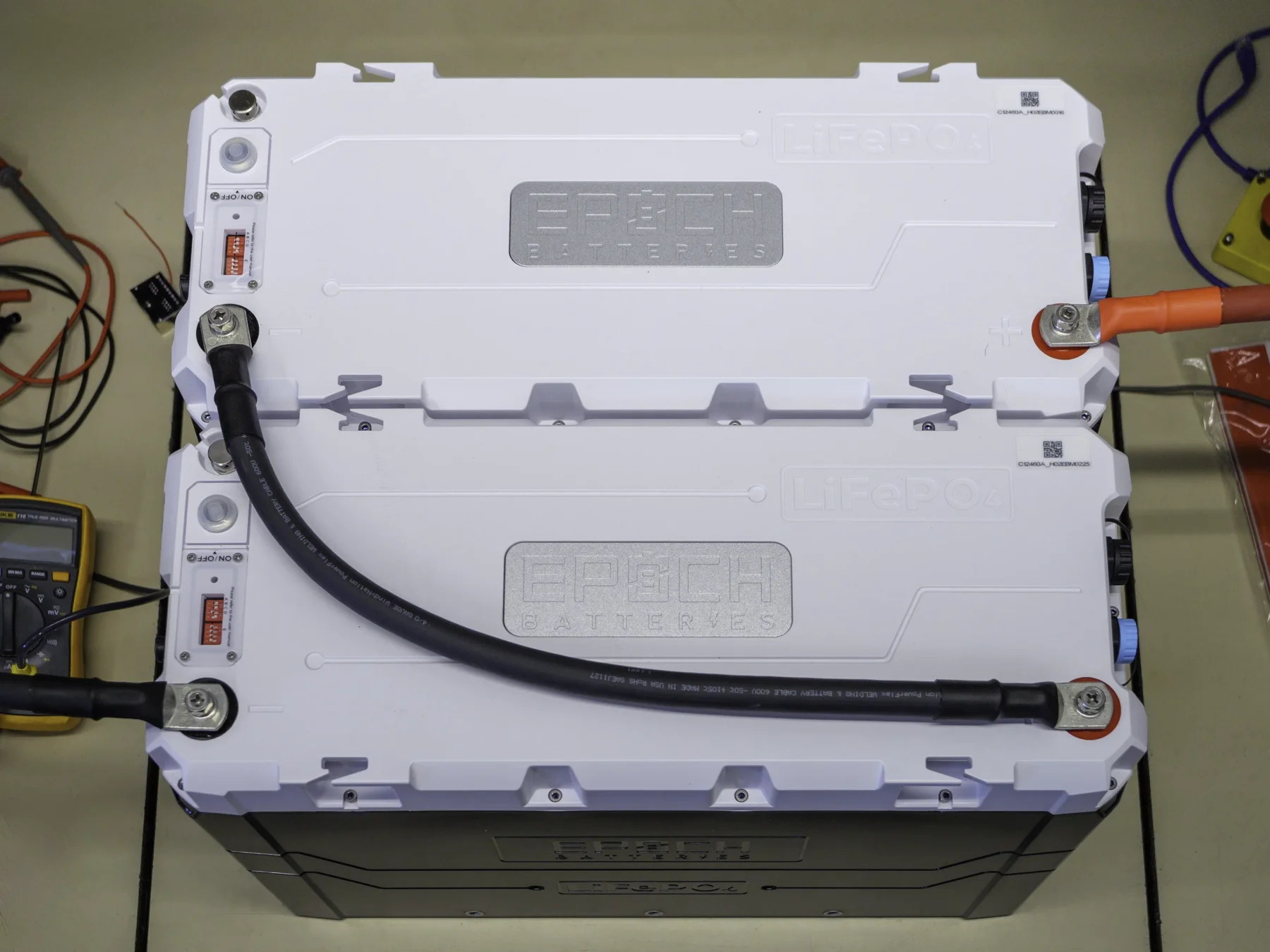
The BMS Isolation Problem
Every drop-in lithium battery you buy has its own internal BMS. That BMS monitors the cells inside its own enclosure, balances them relative to each other, and disconnects the battery if it detects an unsafe condition like overvoltage, undervoltage, overcurrent, or extreme temperature.
The BMS does this job well for a single battery. The problem is that when you wire multiple batteries in series, each BMS is operating independently with zero visibility into what the other batteries in the string are doing.
Battery #1's BMS doesn't know that Battery #3 is at 95% state of charge while Battery #1 is at 88%. It doesn't know that Battery #2's cells are running slightly warmer and accepting charge at a different rate. It doesn't know that Battery #4 hit its high-voltage cutoff 30 seconds ago and disconnected from the string.
Each BMS is making life-or-death decisions about its own battery based on incomplete information. And because they're in series, one bad decision affects the entire string.
What Actually Happens: The Cascade Failure
This training tool shows four 12V lithium batteries wired in series for a 48V system. Each battery has its own independent BMS that will disconnect if its voltage goes too high or too low. Use the sliders to adjust individual battery voltages and the charger's set voltage, then watch what happens when a BMS trips.
Try it: Click "One Battery Drifts High" or drag Battery 3's voltage above 14.6V. Watch the BMS disconnect and see what voltage appears across its terminals. Then read below for why this happens.

Series Battery Voltage Drift Demo
Why 12V LiFePO4 batteries with independent BMSs fail
Why this is dangerous: When a BMS disconnects its battery, it creates an open circuit. No current flows, so the remaining batteries stay at their current voltages. But the system voltage remains unchanged. The difference between the system voltage and the connected batteries appears as open-circuit voltage across the gap. If the BMS reconnects due to hysteresis, vibration, or temperature drift, that full voltage is forced into a single cell, far exceeding its safe limit.
Try it: Use the "Uneven Aging" preset, then slide the system voltage up. Watch one battery trip first, then keep increasing. All that extra voltage piles onto the disconnected battery's gap.
The safe alternative: Use a single, centralized BMS that monitors all cells in the string and controls one main contactor. When any cell reaches a threshold, the entire string is disconnected at once, preventing any open-circuit voltage buildup across individual cells.
Here's the failure sequence we see on support calls, typically in systems without proper balancing equipment or with incorrect charge settings.
You have four 12V batteries in series for 48V. Over time, small differences in internal resistance, cell quality, temperature exposure, and charge acceptance cause the batteries to drift apart in state of charge. In a well-maintained system with a good equalizer, these differences stay small and manageable. Without one, or with an always-on equalizer that tries to balance on the flat part of the LiFePO4 voltage curve (where voltage differences don't reliably reflect SOC differences), the drift can grow.
Battery #3 reaches full charge first. Its BMS detects cell overvoltage and disconnects to protect itself. This is the BMS doing exactly what it's supposed to do. The battery is now an open circuit.
But here's what happens next: the charge controller is still trying to push current into a string at 58V. The three remaining batteries are sitting at roughly 13V each, accounting for about 39V across their terminals. The remaining voltage, roughly 19V, gets forced across the open terminals of the disconnected battery. It's not that the other batteries absorb the extra voltage. It's that the disconnected battery becomes the point in the circuit where the voltage difference accumulates.
A 12V lithium battery seeing 19V across its terminals while its BMS is disconnected is in a dangerous situation. The BMS opened to protect the cells, but the physics of the series circuit are now working against it. If the charge controller doesn't detect the fault and shut down quickly enough, that sustained overvoltage can damage the battery, the BMS, or both.
Forum users on DIY Solar Power Forum documented a version of this scenario with 12V batteries wired four in series for 48V. One battery in the third position consistently showed 17V across its terminals when its BMS disconnected, because the charge controller kept pushing voltage across the string. The owner acknowledged the issue had been happening for some time before taking action. Eventually a battery failed catastrophically, with the case breached and charred. This is an extreme outcome, not the typical one, but it illustrates what can happen when a series system lacks proper balancing and warning signs go unaddressed.
This isn't a manufacturing defect. This is what happens when independent BMS boards in a series string can't coordinate with each other, and the charge controller has no way to know that one battery has dropped out of the circuit.
Even the Manufacturers Know
If you read the fine print on series connection policies from major lithium battery manufacturers, you'll notice a pattern. Most allow series connections on their 12V batteries, but the conditions are strict and getting stricter.
SOK Battery's own support documentation states the core issue clearly for their 12V products: "The BMS within the battery only is intended to monitor and balance the cells within the battery enclosure it is mounted in. When batteries are in series, one battery has no idea what is going on with the rest of the chain." They recommend an external battery balancer for any series configuration, monthly manual voltage checks for systems without one, and fully charging each battery individually before connecting them in series.
Their newer 48V server rack batteries don't allow series connections at all, though that's a different issue. The MOSFETs on those BMS boards aren't rated for the voltages you'd see in a 96V or 192V string. It's a hardware limitation, not a balancing concern.
There are manufacturers who have solved the series problem at higher voltages, but they do it with purpose-built architecture. Pytes, for example, makes 48V packs that can be connected in series for high-voltage systems, but they use a Battery Management Unit (BMU) that sits above the individual packs and coordinates balancing across the entire string. The BMU has visibility into every pack's state of charge and can actively manage the relationship between them. This is fundamentally different from wiring together independent batteries with isolated BMS boards that can't see each other.
That distinction matters. Series lithium can work when the system is engineered for it from the ground up with centralized management. The problems we see on support calls come from people stringing together drop-in 12V batteries that were never designed to coordinate across a series string.
The Workarounds and What They Actually Require
Series lithium connections can work reliably with the right equipment and setup. The issue is that most of the problems we troubleshoot come from systems where one or more of these steps was skipped or done incorrectly.
Top balancing before commissioning. This is essential and we cover it in detail in our series vs. parallel guide. Charging every battery to 100% individually, letting them rest, and verifying they're within 0.1V before connecting them in series. This gives you a solid starting point and is non-negotiable for any series configuration.
External battery equalizers. There are two common types. Resistive balancers (like the Victron Battery Balancer) bleed excess energy from the higher-voltage battery as heat to bring it in line with the others. Capacitor-based equalizers actively transfer energy between batteries in pulses. Both types can keep a series string well matched over time. The Victron Battery Balancer is designed to activate at the right point on the charge curve, which is important. On the flat portion of the LiFePO4 voltage curve (roughly 13.0V to 13.3V), a small voltage difference between batteries can represent a large SOC difference. An always-on equalizer working in this range may actually push energy in the wrong direction as batteries age, because it's chasing voltage parity on a curve where voltage doesn't reliably reflect state of charge. Equalizers that activate near the top of the charge curve, where the voltage rise is steep and meaningful, balance accurately. We can't speak to when other brands activate, so if you're using a non-Victron balancer, verify that it isn't running continuously on the flat part of the curve.
Regular full charge cycles. Bringing the entire string to full absorption voltage regularly gives every battery's BMS a chance to internally balance its own cells and gives you a known reference point. Systems that routinely stop charging before reaching full absorption lose this benefit.
These practices work. The people running well-configured series systems with proper equalizers and correct charge settings generally don't have problems. But it's worth being honest about what "well-configured" requires: the right type of equalizer, correct charge settings that allow full absorption, proper initial balancing, and the discipline to maintain it all over the life of the system. When any piece of that chain is missing or wrong, the support calls start.
This is why, when customers ask us what we'd recommend, we point them toward native-voltage batteries every time.
The Simpler Path: Buy the Right Voltage
Series connections with lithium can work with the right equipment, the right settings, and ongoing attention. We're not going to tell you it can't be done. But if you asked any of us what we'd put on our own homes, the answer is a native-voltage battery every time. Here's why.
A single 48V lithium battery has one BMS managing all the cells internally. That BMS has full visibility into every cell's voltage, temperature, and state of charge. It can balance cells against each other in real time because they're all inside the same enclosure on the same board. No equalizer to buy, install, and verify. No charge settings to tune for inter-battery balancing. No extra components between you and a system that just works.
There's also a manufacturing advantage that's easy to overlook. When you buy four separate 12V batteries, even from the same brand on the same day, each one was assembled with cells that were graded and matched independently. The manufacturer matched cells within each battery, but nobody matched cells across batteries. You're relying on manufacturing consistency across four separate production events. A single 48V pack was built as one unit with all 16 cells selected, matched, and tested together from the same batch. That's a level of cell matching you can't achieve by buying four boxes off a shelf.
Even if the price were identical, a single 48V pack with factory-matched cells and one BMS is a better starting point than four 12V batteries that need an equalizer, careful charge configuration, and initial balancing just to get to the same place.
Need Help Choosing the Right Battery?
Our team designs battery systems every day and can help you pick the right configuration for your application. If you're currently dealing with series connection issues, we can help troubleshoot those too.
A good equalizer makes a big difference, and we recommend one for any series configuration. The key is choosing one that activates at the top of the charge curve rather than running continuously. On the flat middle portion of the LiFePO4 voltage curve, small voltage differences don't reliably reflect state of charge, so an always-on equalizer can actually push energy the wrong direction as batteries age. An equalizer that activates near full charge, where the voltage curve is steep and meaningful, balances accurately and keeps the batteries well matched over time.
This is where it gets nuanced. Some manufacturers like Pytes build 48V packs specifically designed for series connections, using a Battery Management Unit (BMU) that coordinates balancing across all packs in the string. The BMU has full visibility into every pack's state of charge and can actively manage the relationship between them. That's a purpose-built solution and it works. The problems we describe in this post come from wiring together independent drop-in batteries with isolated BMS boards that have no centralized coordination. If you need a high-voltage series configuration, look for systems with a BMU architecture rather than trying to make standalone packs cooperate.
Not necessarily. If your system is working reliably, maintain it properly: install an external balancer if you don't have one, do periodic voltage checks, and fully top-balance the string at least quarterly. If you're experiencing frequent BMS disconnects or shutdowns, it may be time to transition to a native-voltage battery bank. Our team can help you plan a migration path that doesn't require replacing everything at once.
Absolutely. With the right equalizer (one that activates at the top of the charge curve, not always-on), correct charge settings that allow full absorption, and batteries that were properly matched before commissioning, series systems run reliably. The reason we recommend native-voltage batteries when possible is simplicity: one pack, one BMS, factory-matched cells, no external balancing equipment, fewer things to configure. Both approaches work. One just requires less from the owner.
You have two paths. The first is to wire four 12V batteries in series with an external balancer and accept the maintenance requirements. The second, and what we recommend, is to sell or repurpose the 12V batteries and buy a 48V pack designed for your system voltage. A single 48V 100Ah server rack battery often costs less than four quality 12V 100Ah batteries and eliminates the balancing problem entirely.