
Series vs. Parallel Battery Connections Explained
Series vs. parallel battery connections, when to use each, and how to properly balance your LiFePO4 battery bank for 12V, 24V, and 48V systems.
If you're building a battery bank for solar, off-grid, or mobile power, one of the first things you need to understand is the difference between series and parallel connections. These two wiring methods do fundamentally different things, and mixing them up leads to poor performance or damaged equipment.
The concepts are simple once you see them clearly. This guide covers both connection types, explains when to use each, and walks through the balancing steps that are critical when working with LiFePO4 batteries.
Parallel Connections: More Capacity, Same Voltage
Parallel means wiring positive to positive and negative to negative. The result: your total capacity in amp-hours and maximum discharge current (amps) increase, but the voltage stays the same.
Example: a single 12V 100Ah LiFePO4 battery delivers up to 100 amps continuous and stores 100 amp-hours of energy. Connect two in parallel and you have a 12V 200Ah bank. The voltage hasn't changed, but you've doubled your stored energy and output current.
That 200Ah bank could run a 10-amp load for 20 hours, or a 20-amp load for 10 hours. Add a third battery, and you're at 300Ah. Most LiFePO4 batteries support 4 to 16 units in parallel depending on the manufacturer.
The simple rule: parallel increases capacity and current. Voltage stays the same.
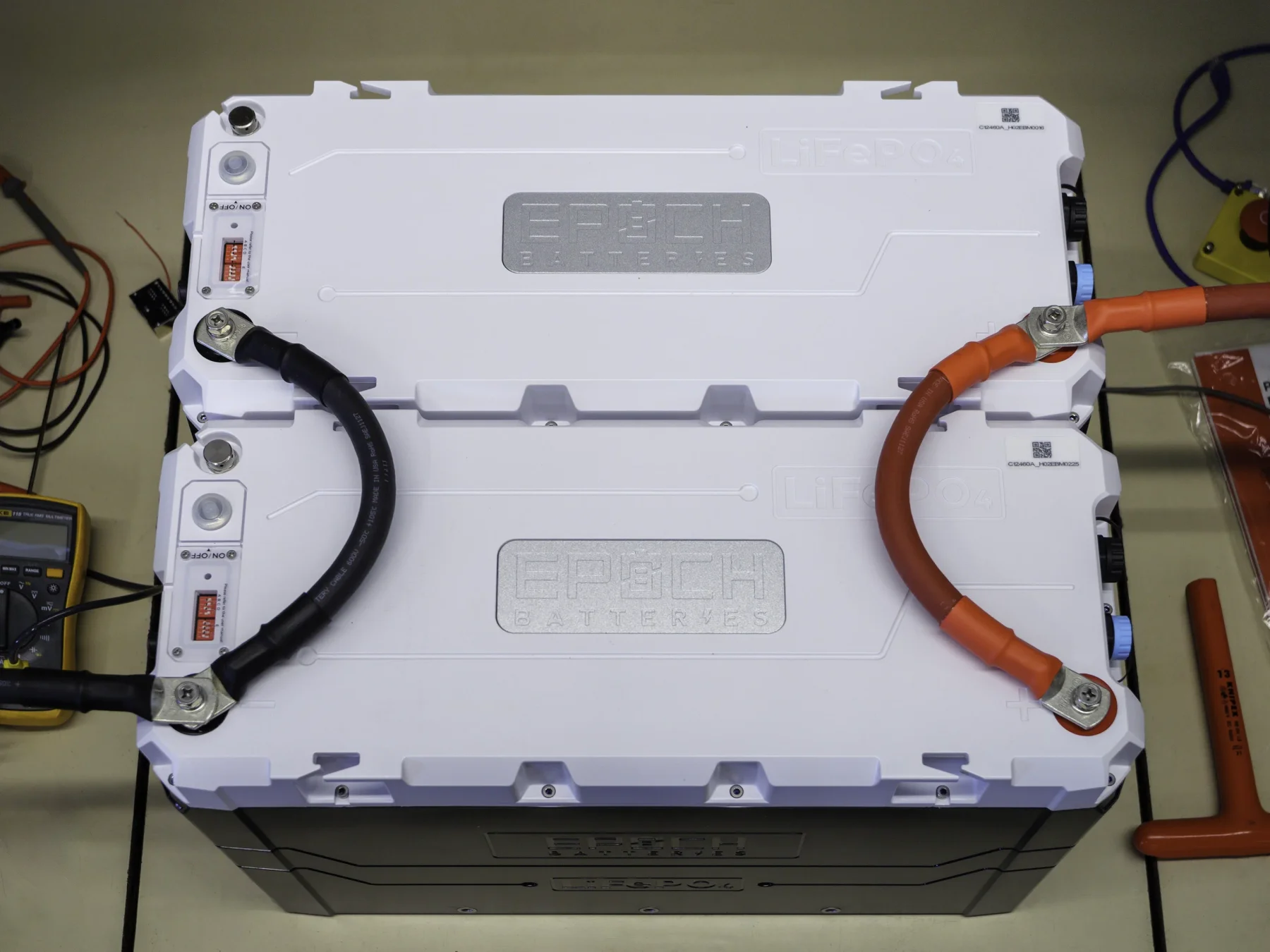
More Voltage, Same Capacity
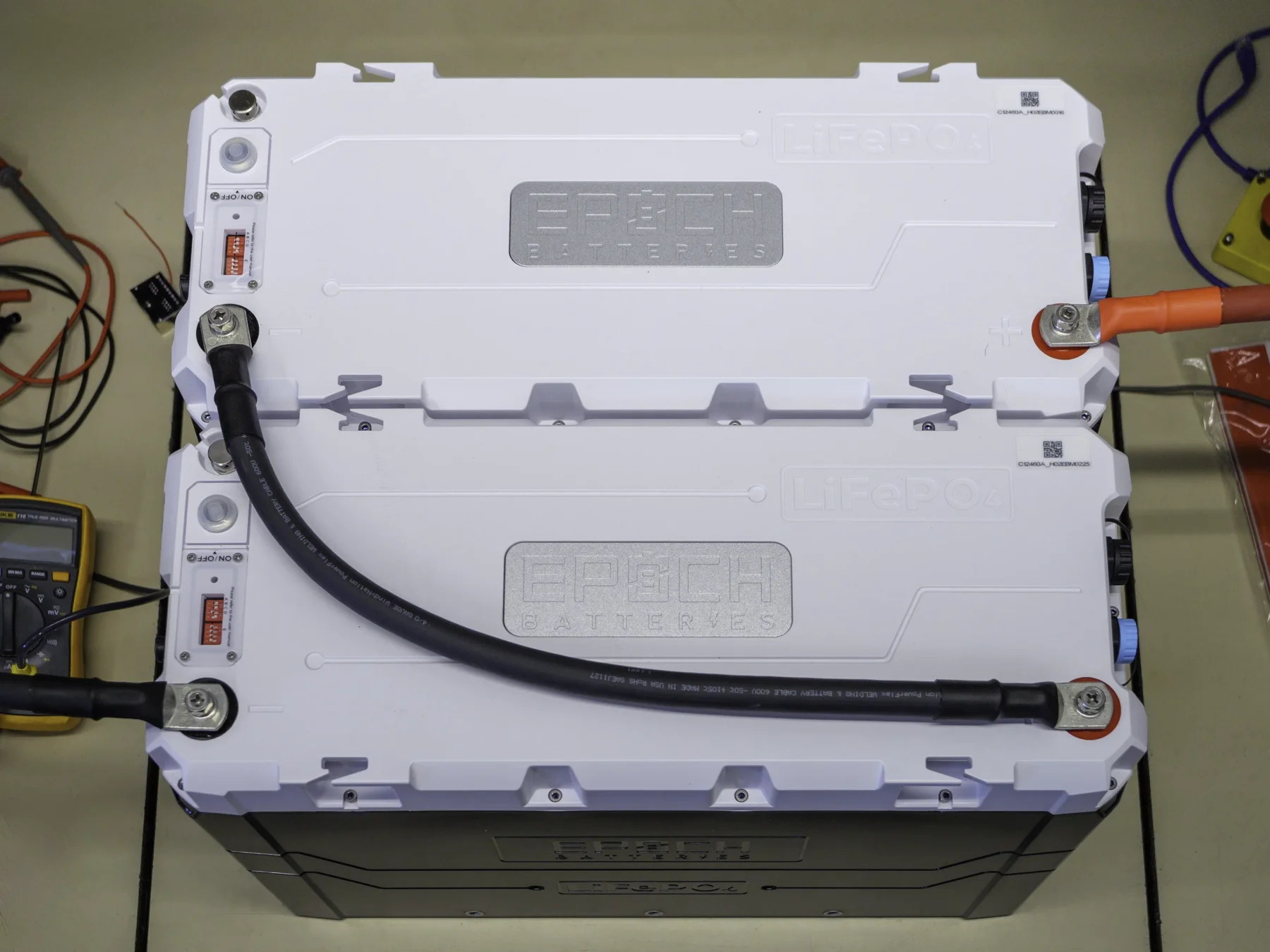
Series means wiring the positive terminal of one battery to the negative terminal of the next. This increases voltage while keeping amp-hours and maximum current the same.
Example: two 12V 100Ah batteries in series give you a 24V 100Ah bank. Four in series gives you 48V 100Ah. The amp-hour rating doesn't change. Only voltage increases.
Why go higher voltage? Efficiency. Higher-voltage systems deliver the same power with less current, which means smaller wires, less heat, and lower losses. This is why most whole-home inverters run at 24V or 48V.
The simple rule: series increases voltage. Amp-hour capacity and current stay the same.
A common misconception: Many beginners assume that connecting batteries in series adds amp-hours too. If you're coming from the lead-acid world, you may have started with 6V golf cart batteries wired in series and assumed two 6V 300Ah batteries would give you 12V and 600Ah. That's not how it works. You'd actually get 12V 300Ah. If you want both higher voltage and more capacity, you need a series-parallel configuration, which we cover next.
What's the difference?
Wiring
Positive to positive, negative to negative
Positive of one to negative of the next
Voltage
Stays the same
Adds up
Capacity (Ah)
Adds up
Stays the same
Max Current (A)
Adds up
Stays the same
Example: 2x 12V 100Ah
12V 200Ah
24V 100Ah
Example: 4x 12V 100Ah
12V 400Ah
48V 100Ah
Primary use
Longer run times, higher current
Higher system voltage for efficiency
Series-Parallel: When You Need Both
Many real-world setups need both higher voltage and more capacity. That's where series-parallel comes in: build series strings first to hit your target voltage, then connect those strings in parallel to add capacity.
Example: you want a 24V 200Ah bank using 12V 100Ah batteries.
- Wire two batteries in series to create a 24V 100Ah string.
- Build a second identical string.
- Connect the two strings in parallel to get 24V 200Ah.
That's four batteries total. For 48V 200Ah, you'd build two strings of four batteries in series (each string 48V 100Ah), then parallel those strings. Eight batteries total.
The key rule: every series string must be identical. Same number of batteries, same brand, same model, same age if possible. Uneven strings cause imbalances that can damage your system.
This is where most people run into trouble.
LiFePO4 batteries ship at roughly 30% state of charge due to shipping regulations. When your batteries arrive, they won't all be at the exact same voltage. The differences might be small, but they matter.
For parallel connections, balancing is easy. Batteries connected in parallel naturally equalize by sharing current until voltages match. It's still best practice to fully charge them before putting them into service, but parallel is forgiving.
For series connections, balancing is critical. Series-connected batteries cannot share energy between each other. If one battery is at 30% and another is at 35%, that imbalance will persist and worsen over time. When one pack hits its high or low voltage cutoff before the others, its BMS disconnects and takes the entire string offline.
The right way to do it:
Before any series configuration, charge every battery individually (or in a parallel group) to 100%. Let them rest for a few hours so the cells can internally balance, then verify each battery is within 0.1V of the others with a multimeter. Once matched, wire them in series.
This applies when adding a new battery to an existing string too. Never bolt a fresh-from-the-box battery into a string that's been running for months.
Quick balancing checklist:
- Charge all batteries to 100% before any series configuration
- Let them rest 2 to 4 hours after reaching full charge
- Verify each battery is within 0.1V of the others
- Never mix brands, models, or significantly different ages in a series string
- Match any new battery's charge level to the existing string before connecting
Common Mistakes to Avoid
Mixing brands or models in a series string. Different batteries have different internal resistances, BMS settings, and voltage curves. Even two "12V 100Ah LiFePO4" batteries from different manufacturers may behave differently under load. Parallel is more forgiving, but series connections demand identical batteries.
Skipping the initial charge balance. The single most common cause of "my system keeps shutting down" calls is an imbalanced series string. A few extra hours of preparation saves weeks of troubleshooting.
Undersized wiring or connectors. Parallel connections increase your bank's maximum current. A 4-battery parallel bank of 100A batteries can push 400 amps. Your wiring, fuses, and bus bars need to handle the total current, not just a single battery's rating.
Mismatched cable lengths in a parallel bank. The battery on the shortest cable carries more of the load and wears out first. Run equal-length cables from each battery to the bus bar, all sized for the bank's total current. Our custom battery cable builder makes matched sets to your exact length, 6 AWG to 4/0.
No individual fuses. Every battery in a parallel bank should have its own fuse on the positive lead. If a short occurs in one battery or its wiring, the other batteries will dump their full current into the fault. Individual fuses isolate the problem and protect the rest of your bank.
Which Configuration Is Right for You?
12V Systems
RVs, vans, boats, and small off-grid setups. Parallel connections increase capacity while keeping everything at 12V.
24V Systems
Mid-size off-grid cabins and homes. Two batteries in series for 24V, then parallel your strings for more capacity.
48V Systems
Whole-home solar and high-demand applications. Four batteries in series, with parallel strings as needed. Most efficient for larger loads.
Not Sure?
Your inverter or charge controller specifies its required input voltage. Start there, then size capacity based on your runtime needs.
Need Help Sizing Your Battery Bank?
Whether you're building your first 12V setup or wiring a 48V whole-home system, our team can help you pick the right batteries and make sure your configuration is solid.
No, and this is one of the most common beginner mistakes. Series connections add voltage, not capacity. Two 6V 300Ah batteries in series give you 12V 300Ah, not 12V 600Ah. To increase both voltage and capacity, you need a series-parallel configuration: build series strings for your target voltage, then connect identical strings in parallel for more amp-hours.
It's not ideal but more workable in parallel than in series. Older batteries with some cycle degradation will contribute less and may hit their low-voltage cutoff sooner. For series strings, always use batteries of the same age and condition.
Depends on the manufacturer's specs. Most LiFePO4 brands support 4 to 16 units in parallel. Check your product documentation. More parallel batteries means more capacity and current, but also more complexity in wiring and fusing.
If you're using drop-in LiFePO4 batteries with built-in BMS (which is standard), you don't need an external BMS. Each battery manages its own cells. Some advanced setups using raw cells without built-in management do require an external BMS.
Its BMS disconnects and breaks the entire series circuit, taking the whole string offline. This is why balancing matters and why you should use identical, matched batteries. In a parallel bank, one battery disconnecting has less impact since the others continue supplying power.
It depends on your maximum current and cable run length. Many 12V systems use 4 AWG or 2 AWG cable, while 24V and 48V systems can often use slightly smaller gauges since current is lower for the same power output. Always size wiring for the full current capacity of your bank, not just your expected load. Our team can help you spec the right cable.
Yes, as long as your charger matches the bank's configuration. For parallel, set the charger to single-battery voltage (e.g., 14.6V for 12V LiFePO4). For series, match the total string voltage (e.g., 29.2V for two in series, 58.4V for four). Always use a charger with a LiFePO4-compatible charge profile.
No. This is something you should never do regardless of battery chemistry. With lead acid batteries, tapping a single battery in a series string causes uneven charging that leads to gassing and boiling the electrolyte, which is both dangerous and destructive to the battery. With lithium (LiFePO4), you won't get boiling, but you create a balancing nightmare. One battery gets drained while the other doesn't, and since series-connected batteries can't share energy, the imbalance compounds with every cycle. The overworked battery hits its BMS cutoff first, takes the whole string offline, and you're stuck troubleshooting a problem that never should have existed. If you need both 12V and 24V in the same system, use a DC-DC converter to step down from 24V to 12V. Both batteries share the load equally, stay balanced, and you avoid damaging your equipment.