Victron Energy 12V Battery Balancer for Series-Connected Batteries, Supports Multiple Parallel Connections
SKU: BBA000100100
Product Summary
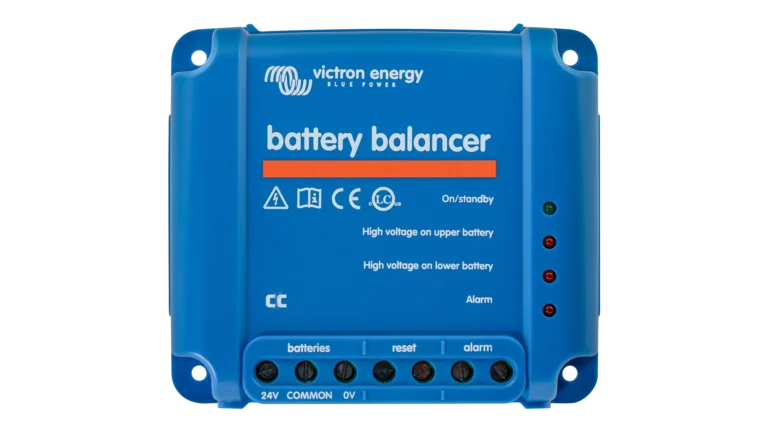
The Victron Battery Balancer equalizes voltage across two series-connected 12V batteries during charging, preventing the state-of-charge drift that causes overcharging and sulfation in lead-acid battery banks. It activates automatically when total charge voltage exceeds 27.3V and draws up to 0.7A from the higher-voltage battery until both match. A built-in alarm relay triggers when the voltage difference exceeds 200mV.
Specifications:
- Application: 24V and 48V systems using series-connected 12V lead-acid batteries
- Maximum Balance Current: 0.7A (at >100mV deviation)
- Turn-On / Turn-Off Voltage: 27.3V / 26.6V across battery pair
- Alarm Relay: Normally open, 60V/1A (triggers at 200mV deviation)
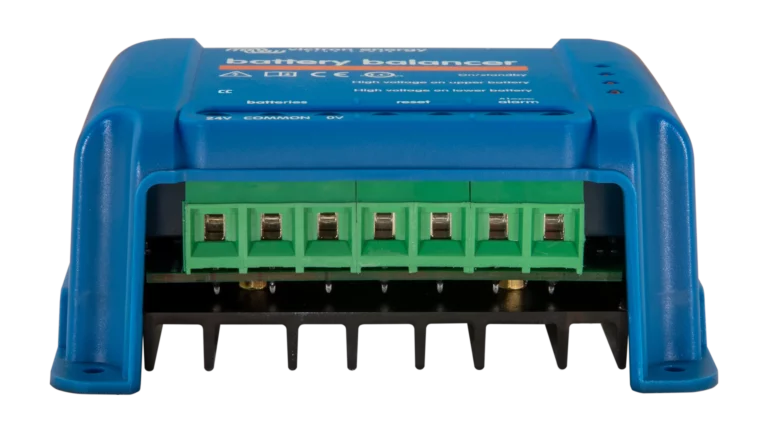
- Connection: Screw terminals, AWG 10
- Operating Temperature: -22°F to 122°F (-30°C to +50°C)
- Dimensions: 4.0 x 4.4 x 1.9 in
- Weight: 0.9 lbs
Log in to check member price and detailed stock information.
Log in to see additional stock details


Current Connected is YOUR Victron product specialist
About the Victron Battery Balancer
When 12V lead-acid batteries are connected in series to build a 24V or 48V bank, small differences in internal resistance, self-discharge rate, or initial state of charge cause individual batteries to drift apart over time. The higher-voltage batteries get overcharged while the lower-voltage batteries get undercharged. Overcharging accelerates plate corrosion and gassing. Undercharging causes sulfation. Both shorten battery life significantly. The Battery Balancer addresses this by actively equalizing voltage across each pair of series-connected batteries during every charge cycle.
How the Battery Equalizer Works
The balancer connects across a pair of series-connected 12V batteries using three wires: positive, midpoint, and negative. When the total voltage across the pair rises above 27.3V during charging, the balancer activates and compares the two battery voltages. If the deviation exceeds 50mV, it begins drawing current (up to 0.7A) from the higher-voltage battery, allowing the lower-voltage battery to receive proportionally more charge current. When charging stops and total voltage drops below 26.6V, the balancer returns to standby drawing less than 1mA.
How Many Balancers for a 24V or 48V System
A single Battery Balancer handles one pair of series-connected 12V batteries. A 24V system (two batteries in series) needs one balancer. A 48V system (four batteries in series) needs three balancers, one across each adjacent pair, daisy-chained from positive to negative across the full string. For parallel strings at the same voltage level (such as multiple batteries in parallel at each position in the series chain), a single balancer per pair handles up to about three parallel 200Ah strings. Larger parallel banks may benefit from a second balancer in parallel at each position.
LED Status and Alarm Relay
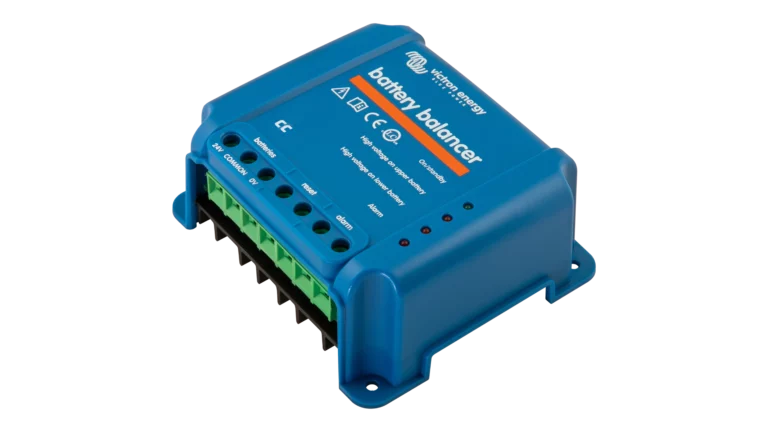
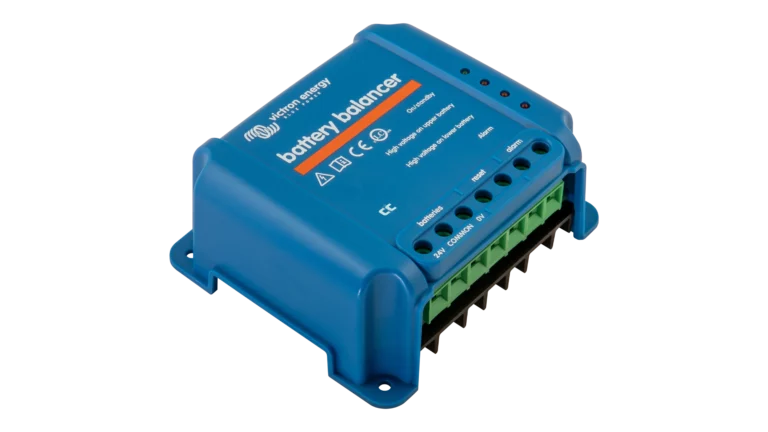
Three LEDs show the balancer's operating state at a glance. Green means active (total voltage above 27.3V). An orange LED lights when deviation exceeds 100mV, indicating which battery is being balanced. The red LED triggers at 200mV deviation, signaling a problem that balancing alone may not resolve. The alarm relay (normally open, rated 60V/1A) closes when the red LED activates and stays closed until the deviation drops below 140mV. Two additional screw terminals accept an optional push button for manual alarm reset.
Balancing Series-Connected Lithium Batteries
Lithium batteries with an internal BMS balance cells within each individual battery, but the BMS has no visibility into other batteries in a series string. Two or more 12V lithium batteries wired in series for a 24V or 48V system can drift apart over time just like lead-acid, and neither BMS can correct for it. The Battery Balancer handles this inter-battery equalization, complementing the cell-level balancing that each BMS does internally. Parallel-connected batteries do not need a balancer, since batteries wired in parallel share the same voltage naturally.
Recommended Accessories
Frequently Asked Questions
No. The Battery Balancer is rated for a maximum of 18V per battery and 36V total across the pair. Two 24V batteries in series would put approximately 48-58V across the unit, exceeding its input rating. This product is specifically designed for 12V batteries connected in series. A 48V system built from 12V batteries requires three balancers wired across each adjacent pair in the string.
One per pair of series-connected 12V batteries. One for 24V, three for 48V. If you have parallel strings, a single balancer per pair handles up to about three parallel 200Ah strings. Larger parallel banks may benefit from adding a second balancer at each position.
No. Batteries wired in parallel share the same voltage and equalize naturally. A balancer is only needed for series connections where individual battery voltages can drift apart.
The red LED and alarm relay activate when voltage deviation exceeds 200mV. For a new bank, this usually means the batteries had different initial states of charge. Reduce charge current and allow several cycles for the balancer to equalize them. If the alarm persists, it may indicate a failing cell or systematic undercharging. Check individual battery voltages during absorption charging to isolate the problem.
Yes. While each lithium battery's internal BMS balances the cells inside that battery, it has no visibility into the state of charge of other batteries in the series string. Two 12V lithium batteries wired in series for 24V can drift apart the same way lead-acid batteries do, and neither BMS can correct for it. The Battery Balancer equalizes voltage between the batteries in the string, complementing what the internal BMS does within each one.
Customer Reviews
No reviews yet. Be the first to review this product!